
Build your bike quiver with this handy guide
We are at a pinnacle of mountain biking tech and design. With more brands, builds, and types of mountain bikes available than ever before, there is truly a bike (or 3!) for everyone. New categories are even emerging that blend ride qualities (hello, Downcountry), expanding the versatility of bike quiver slots to new heights. And, we haven’t even started talking about eMTBs.
All of this variety and category blending can make the bike buyer’s head spin. Fear not, our guide to mountain bike quiver slots is here to break down the choices so you can find your perfect bike.
A brief primer on how to choose a bike
The first and most important thing to consider when buying a bike is where you are going to ride it. Rowdy lift-served downhill laps ask something totally different from a bike than endurance cross country racing, for instance. The terrain (chunky desert riding vs. smooth single track berms), and the kind of riding (Enduro race vs. casual weekend rides) are the foundation of your quiver slot choice. There is some gray area here (more on that in a bit), but for the most part, determining where and how is the right place to start.
Once you nail down the category of bike, you can start considering whether to go for a carbon or aluminum frame, what level of components you need, and what fits into your budget. We’ll save that for another post, but for now, here’s a breakdown of modern bike categories, along with a few of our favorite whips in each one.
Cross Country
Cross country bikes have come a long way. Once relegated to minimal travel and steep headtube angles for maximum efficiency, they've evolved to be slacker with more suspension at no weight penalty. Today's modern cross country bikes typically feature stiff carbon frames, up to 120mm of travel and more capable geometries. Whether you're looking to toe XC start lines or embarking on long rides where both lightweight and capable are the priority, today's modern cross country bikes fit the bill.

The Specialized Epic 9 is a 120mm Cross Country bike that prioritizes climbing efficiency while being exceptionally capable downhill.
With the growing adoption of automatic suspension systems like Sram's Flight Attendant, XC bikes are capable of even greater efficiency than ever before. Flight Attendant listens and responds to rider movement and terrain, stiffening and opening the fork and shock at optimal times to maximize pedaling efficiency on climbs and undulating terrain.
Available in carbon and aluminum frames, Cross Country bikes can weigh anywhere from an airy 18.88 lbs for the new fully suspension S-Works Epic 9 LTD to a more substantial 28lbs on lower end buildkits. Regardless of frame and components, by choosing an XC bike, you’re prioritizing pedaling efficiency and speed over the playful downhill performance you’d get from a bigger-travel bike. As cross country bikes evolve, however, the compromise becomes less pronounced.
Our favorite XC bikes
Trail
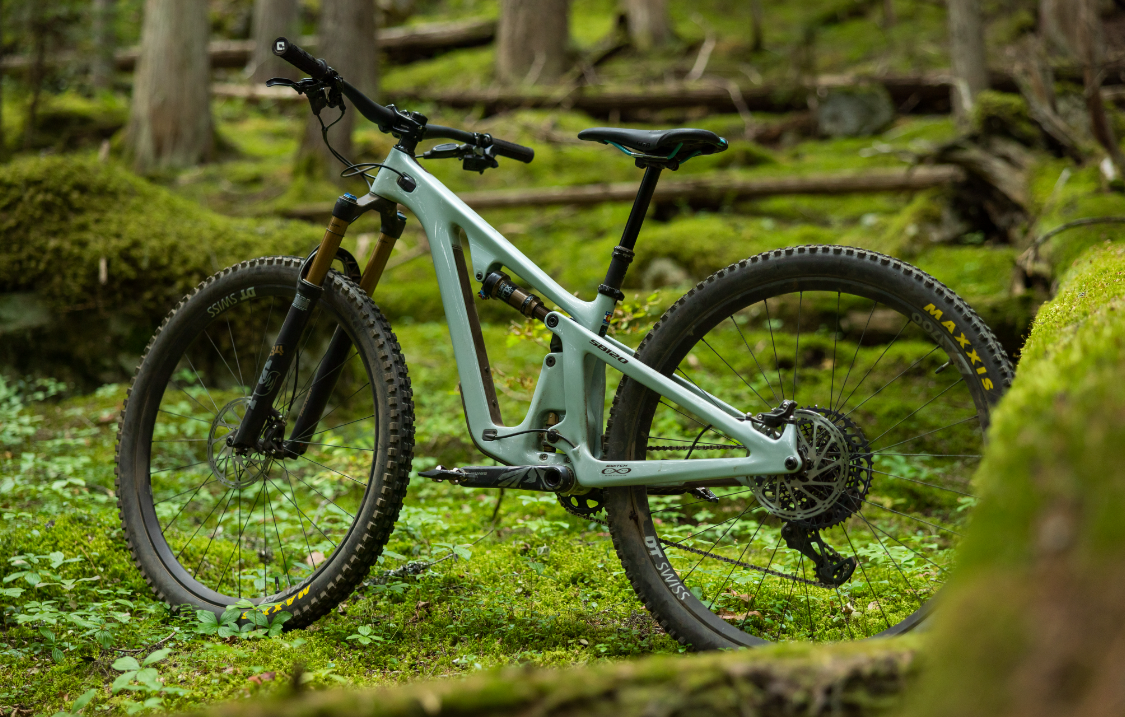
If versatility is your jam––cruising your local flow trails during the week and hitting technical climbs and descents on the weekends––the broad Trail category is sure to satisfy. With front and rear travel that averages 120mm–150mm, relaxed geometry, and options for fast rolling 29” wheels or more maneuverable 27.5” wheels, Trail rigs are designed for riders who want to climb and descend any kind of terrain the mountains throw their way, and to have a good time doing it.

The new Santa Cruz Tallboy is designed to zip up climbs and desliver confident, playful descending.
Trail bikes prioritize the enjoyment of the ride. They’re designed to climb energetically, maneuver aptly through technical sections, and provide confident stability when things get steep and rocky. In general, trail bikes feature more relaxed geometries than their XC brethren, with slacker head tubes for stability downhills, shorter chainstays for maneuverability, and steeper seat tube angles to position the rider directly over the bottom bracket for comfortable and efficient pedaling. The Trail bike category averages 30lbs in weight, leaning away from climbing efficiency prized by lighter XC and Downcountry bikes, but tipping toward versatility and fun.
Since this is such a broad category, there’s overlap between shorter-travel Trail bikes and Downcountry rides, as well as bigger travel Trail bikes and Enduro rigs. In general, less travel bikes like the Pivot 429 Trail and Yeti SB130 will offer more efficient climbing, and bigger travel bikes like the Specialized Enduro and Santa Cruz Bronson will take big downhill hits with a little more panache. Whether you choose a Trail bike in the 130mm–140mm range or one in the 140–150mm range, rest assured you’re getting a bike made to maximize fun no matter what the trail throws at it.
Our favorite Trail bikes
Enduro
When the uphill climb is more of a necessary step to get to that steep, gnarly descent with mandatory drops and air time, Enduro bikes shine. With slacked headtube angles and big suspension (150mm–180mm front and rear), Enduro bikes are designed for major shock absorption and stability at high speeds, like in Enduro races where pedaling is required but podiums are reached through speed and agility on the descents. Most Enduro bikes are also available in 29”, 27.5”, or mixed (mullet) 29” and 27.5” combos, allowing you to prioritize efficient rollover, maneuverability, or the best of both.
The Pivot Firebird is a modern Enduro bike with big travel and relaxed, slack geometry to handle big hits and feel stable at high speeds but can pedal uphill decently well.
While Enduro bikes can pedal uphill, their geometry prioritizes downhill prowess. They generally have a longer wheelbase, bigger reach, and slacked out front end than Trail bikes which allows them to stay stable and planted at high speeds on rough and steep terrain. This, coupled with their lofty travel, makes them slightly less maneuverable than Trail and XC bikes, but also lets the rider point and go, knowing the bike is designed to handle the rough stuff. Some Enduro bikes feature ‘mullet’ mixed wheelsets that put the fast, rollover characteristics of 29” in the front and the snappy maneuverable 27.5” wheel on the back for a playful, hard charging trail machine.
Enduro bikes meet their full potential in the Enduro race format, but they’re also ideal for riders who just really want to have fun on the descents.
Our favorite Enduro bikes
eMTB
E-Mountain Bikes (eMTB) are the fastest growing segment in the mountain bike world. With good reason, the battery-powered, motorized-assist of an eMTB makes long, arduous climbs a breeze and lets your once-a-year epic become a weekly occurrence with no sacrifice to the agility and capability you expect from a non-assisted mountain bike. The ever-expanding eMTB options mean you have a choice of riding style, battery range, travel and geometry, as well as removable batteries to turn your eMTB back to a traditional rig.

The Santa Cruz Heckler eMTB offers outstanding downhill capabilities and a motorized boost that makes climbs and long rides a breeze.
While there are a variety of eMTB ride styles, the area seeing the biggest growth is in the Trail/Enduro/Downhill category. Bikes like the Specialized Levo, Santa Cruz Heckler, and Pivot Shuttle SL offer exceptional downhill performance with a mechanical boost for climbing and traversing long distances. EMTBs solve the pedaling efficiency that’s missing from most Enduro and Downhill bikes for a new category of bike that is truly limitless.