Weston Backwoods Carbon Splitboard

$1,349.00
Shipping calculated at checkout.

Size

Weston Backwoods Carbon Splitboard - 157 is currently backordered and we will reach out with in 24 hours with an up-to-date ETA.

Lightweight Powder and Freeride Splitboard

Weston Backwoods Carbon Splitboard

The Weston Backwoods Carbon Splitboard is a lightweight powder and freeride splitboard for riders who want float in deep snow without paying for it on the skin track. A tapered directional shape running 308-256-290 mm at 157 cm carries 18 mm of taper and a multi-radial sidecut that tightens to 6.7 m underfoot, so a wide nose does the floating while the board still comes around in tight trees. At 2,776 g per board in a 157, with a paulownia and poplar core stiffened by vertical aluminum stringers and a carbon layup, the Backwoods Carbon suits long tours, multi-day traverses and storm days where the objective is snow rather than steepness.

Expert Review Ratings and sizing guidance verified against manufacturer specifications.

Is This the Right Splitboard for You?

Best For
Riders who tour long distances for powder, want a wide nose and heavy taper for float in trees and deep snow, and value 2,776 g per board in a 157 over maximum stiffness.
Consider Another Splitboard If
You ride mostly firm snow, want a stiffer board for high-speed steeps, or prefer a longer sidecut for open terrain. The 18 mm taper trades tail hold for release.

CCBB Splitboard Ratings

Uphill Efficiency
4/5
2,776 g per board (157 cm)
Downhill Performance
4/5
Mid-stiff flex, camber underfoot
Soft Snow Float
5/5
308 mm nose, 18 mm taper
Firm Snow Grip
4/5
Camber underfoot, full inner steel edge

Rating scale: 5 = top of its class, 4 = excellent, 3 = good, 2 = specialized or below average, and 1 = limited.

CCBB Splitboard Profile

Dimensions308-256-290 mm (157 cm)
Turn Radius7.5 / 6.7 / 7.8 m multi-radial (157 cm)
Rocker ProfileFreeride camber, rockered nose and tail
Flex PatternMid-stiff, tail-weighted balance
Core and LaminatePaulownia and poplar with aluminum stringers, carbon layup
Mount Point10 mm setback
Skin FitPre-cut, Splitboard Skin 3 and Skin 5
Recommended UseBackcountry powder and freeride touring

Why We Like It

  • A 308 mm nose against a 290 mm tail gives 18 mm of taper, and that taper is what sinks the tail and lifts the nose without needing extra length.
  • The multi-radial sidecut runs 7.5 m at the nose, tightens to 6.7 m underfoot and opens to 7.8 m at the tail, so turn initiation is quick while the tail still finishes the arc rather than washing out.
  • Vertical aluminum stringers through the paulownia core add torsional stiffness and damping without bulk, which is how the board holds 2,776 g and still settles down in chop.
  • The touring bracket sits shifted and the board is balanced tail-heavy on purpose, and both of those make a kick turn on a steep, firm skin track less of a fight.

Best Uses

  • Deep snow and tight tree riding
  • Long tours and multi-day traverses
  • Storm days where float matters more than steepness
  • Riders sizing down without giving up nose width
  • Splitboarders 135 lbs and up across the four sizes

Splitboard Selection Advice

Size the Weston Backwoods Carbon on boot size first, because the size run widens fast. The 157 runs a 25.6 cm waist and caps at a US 10 men's boot. The 160 moves to 25.9 cm and a US 11.5. The two wide sizes jump considerably: the 163W sits at 27.4 cm for boots up to US 13.5, and the 167W at 28.1 cm for up to a US 15. A rider with a US 12 foot who sizes on weight alone into the 160 will drag heel and toe on a hard traverse.

The heavy taper changes how the board wants to be ridden and set up. With 18 mm of taper and 10 mm of setback already built into the shape, there is little reason to move the stance further back, and doing so pushes the nose rocker out of the snow rather than into it. Skins are pre-cut and sold separately: the 157 and 160 take Splitboard Skin 3, and the 163W and 167W take Splitboard Skin 5, so a skin set does not carry across a size change.

Size and setup guidance reviewed by CCBB splitboard staff. Confirm size against your weight, boot size and terrain.

Technical Specifications Full spec table · Click to expand

Shape and Sizing

Sizes
157, 160, 163W, 167W cm
Dimensions
308-256-290 mm (157 cm), 312-259-294 mm (160 cm), 327-274-309 mm (163W), 337-281-319 mm (167W)
Waist Width
25.6 cm (157 cm), 25.9 cm (160 cm), 27.4 cm (163W), 28.1 cm (167W)
Sidecut Radius
Multi-radial. 7.5 / 6.7 / 7.8 m (157 cm), 7.7 / 6.9 / 8.0 m (160 cm), 7.8 / 7.0 / 8.2 m (163W), 8.0 / 7.2 / 8.4 m (167W)
Effective Edge
118 cm (157 cm), 121 cm (160 cm), 123.5 cm (163W), 127.5 cm (167W)
Taper
18 mm on all sizes
Setback
10 mm on all sizes
Weight
2,776 g per board (157 cm), 2,876 g per board (160 cm), 3,233 g per board (163W), 3,350 g per board (167W)
Max Boot Size
US 10 men's (157 cm), US 11.5 (160 cm), US 13.5 (163W), US 15 (167W)

Construction and Use

Shape
Tapered directional
Profile
Freeride camber, subtle rocker in the nose and tail with camber underfoot
Core
Strike Split Core, paulownia and poplar with vertical aluminum stringers and bamboo inserts at the binding mounts
Laminate
Carbon fiber layup with flax reinforcement at the touring bracket and insert plates
Base
PTex 5920 graphite with an aluminum tip
Topsheet
Rugged nylon derived in part from castor beans
Sidewall
UHMW, an abrasion-resistant plastic
Edges
Carbon steel, with a full inner steel edge, sidewall and damping tape along the split seam
Split Hardware
Phantom Herc Hooks with Phantom Spinner tip and tail clips, shifted touring bracket position, tail-heavy balance
Skin Attachment
Tip holes and tail notches, Skinlock compatible
Warranty
4 years
Recommended Use
Backcountry powder and freeride touring

Compare the Weston Backwoods Carbon

Backwoods Carbon vs. Weston Backwoods Splitboard

The Weston Backwoods Splitboard is the same shape in a fiberglass layup over a poplar and bamboo core, and it costs less. The Backwoods Carbon uses a carbon layup over paulownia with aluminum stringers to cut weight and sharpen response. Riders chasing distance choose the Carbon. Riders who want the shape at a lower price choose the standard Backwoods.

Shop the Weston Backwoods Splitboard

Backwoods Carbon vs. Weston Japow Splitboard

The Weston Japow Splitboard runs a longer size range up to 169 cm and is built around bottomless snow. The Backwoods Carbon is the more balanced of the two, with enough camber underfoot and edge to handle a firm traverse or a couloir on the way out. Choose the Japow for depth and the Backwoods Carbon for range.

Shop the Weston Japow Splitboard

Backwoods Carbon vs. Jones Howler Splitboard

These sit at opposite ends of the freeride split range. The Jones Howler Splitboard runs full camber with 8 mm of taper at 3,000 g per board in a 158, built for steep, technical descents. The Backwoods Carbon carries 18 mm of taper and a rockered nose at 2,776 g in a 157, built for float and long days. Terrain choice decides, not quality.

Shop the Jones Howler Splitboard
Common Questions

Who should buy the Weston Backwoods Carbon Splitboard?
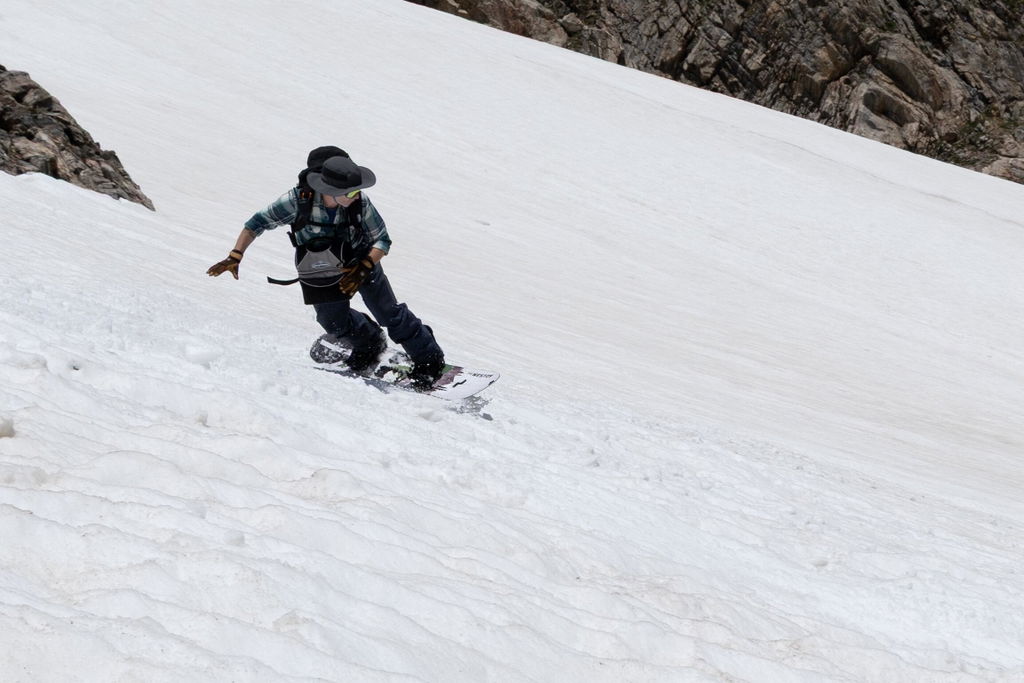
The Weston Backwoods Carbon Splitboard suits riders who tour long distances in search of powder and want float without carrying extra weight. A 308 mm nose with 18 mm of taper at 2,776 g per board in a 157 makes the Backwoods Carbon a deep snow and tree riding tool that still holds an edge well enough for the firm traverse home.
What bindings and skins work with the Weston Backwoods Carbon Splitboard?
The Weston Backwoods Carbon Splitboard takes splitboard-specific bindings that mount to a puck interface and transition between tour and ride mode. Standard solid-board snowboard bindings are not compatible. Skins are pre-cut and sold separately, sized by board: the 157 and 160 take Splitboard Skin 3, and the 163W and 167W take Splitboard Skin 5. The board attaches skins through tip holes and tail notches. Confirm the puck pattern of your binding system against the board before mounting.
Are the metric figures in the Weston size chart reliable?
Two of them are not, and it is worth being direct about it. The published chart lists the 160 as a 150 to 200 lbs board but gives the metric equivalent as 60 to 91 kg, when 150 lbs is 68 kg. It also lists the 167W at 74 inches and above while giving 1.78 m and above, when 74 inches is 1.88 m. Read the imperial columns as the reliable ones on both rows. The dimensions, weights and sidecut figures are internally consistent and match across sizes.
How much does the Weston Backwoods Carbon Splitboard weigh?
The Weston Backwoods Carbon Splitboard weighs 2,776 g per board at 157 cm, 2,876 g at 160 cm, 3,233 g at 163W and 3,350 g at 167W. That puts the shorter sizes among the lighter freeride splits, which is the point of the carbon layup. Any weight quoted for the Backwoods Carbon without a size attached is incomplete.
What does the multi-radial sidecut actually do?
The Weston Backwoods Carbon Splitboard uses three sidecut radii rather than one: 7.5 m through the nose, 6.7 m underfoot and 7.8 m at the tail on the 157. The tighter centre section starts a turn quickly in tight terrain, and the longer radii at each end stop the board from hooking as the edge engages and releases. The effect is a board that turns shorter than its 118 cm effective edge suggests.
Which Weston Backwoods Carbon size fits a US 12 boot?
For a US 12 boot the 163W is the size to look at. The 160 caps at a US 11.5 on a 25.9 cm waist, and the next size up jumps to 27.4 cm with a US 13.5 ceiling. Riders between the two should size on boot clearance rather than rider weight, since heel and toe drag on a firm sidehill is the failure that ends a descent.

Our Verdict

The Weston Backwoods Carbon Splitboard earns its place for riders whose objective is snow rather than steepness. A tapered directional shape at 308-256-290 mm carries 18 mm of taper and a multi-radial sidecut tightening to 6.7 m underfoot, so a nose built for float still turns inside a tree run, and camber underfoot with a full inner steel edge keeps the board honest on a firm traverse. At 2,776 g per board in a 157, the paulownia core with vertical aluminum stringers and a carbon layup is what makes the distance possible. Size it on boot width rather than rider weight, because the run widens quickly above the 160.